
What Is ICAS and Should Your Child Sit It This August? A Parent's Guide
Every Winter, a Familiar Email Arrives
Around this time of year, a message lands in the inboxes of thousands of parents across Australia. It comes from school administration, with a link to a registration form and a modest fee, asking whether you'd like your child to sit the ICAS Assessments this August.
If you're staring at that email right now, you're probably wondering:
- What actually is this test?
- Is it worth the registration fee and preparation time?
- Why do some schools offer it while others don't?
These are completely reasonable questions — and this article is here to give you straight, honest answers.
Why Do Only Some Schools Send the ICAS Email?
If you've noticed that a neighbouring school doesn't offer ICAS while yours does, it comes down to a choice each school makes.
ICAS (the International Competitions and Assessments for Schools) is a completely voluntary, independent academic competition — it is not a government-mandated test like NAPLAN. Because it requires school coordination, teacher supervision, and administration time, some schools choose not to participate.
However, participation has grown significantly in recent years. More educators and parents are recognising that standard classroom testing doesn't always provide enough of an academic stretch for capable students, or enough diagnostic detail to understand exactly where a child is performing globally.
What Is ICAS, Really?
ICAS is an international academic competition run across Australia, New Zealand, Singapore, and more than 40 other countries. It covers subjects including Mathematics, English, Science, Spelling, and Writing, with separate tests available for different year levels.
What makes ICAS different from a school test is its purpose: it isn't assessing whether your child remembered what was taught in class last week. It's designed to measure higher-order thinking, reasoning, and problem-solving — skills that sit above memorisation.
A few things worth knowing:
- Tests are taken during August at the student's own school
- They are time-limited (typically 30–60 minutes per subject)
- Questions deliberately include unfamiliar scenarios to test how students think, not just what they know
- Results come back as detailed diagnostic reports, not just a single score
What Do You Actually Receive From the Results?
This is where ICAS offers genuine value that a school report card can't match.
Because millions of students sit ICAS across dozens of countries, the results provide a statistically reliable international benchmark. The Online Diagnostic Report you receive a few weeks after the test includes:
Precise Percentile Rankings — You'll see exactly where your child places nationally (for example, scoring in the top 5% or top 15% in Australia), rather than just receiving a letter grade.
Skill-by-Skill Breakdown — The report maps out exactly which concepts your child mastered and which they didn't. For Maths, this might distinguish between geometry and algebra; for English, between reading comprehension and textual analysis.
For families considering selective high schools, scholarship programs, or simply wanting a clear academic picture, this level of detail is genuinely useful.

Why Preparation Matters More Than You Might Think
One of the most common experiences we hear from families is this: a student who performs well at school sits ICAS without any preparation, and comes back with a result that doesn't reflect their ability. This can leave a child feeling deflated — not because they aren't capable, but because ICAS is a different type of test that rewards a different type of preparation.
Here's why:
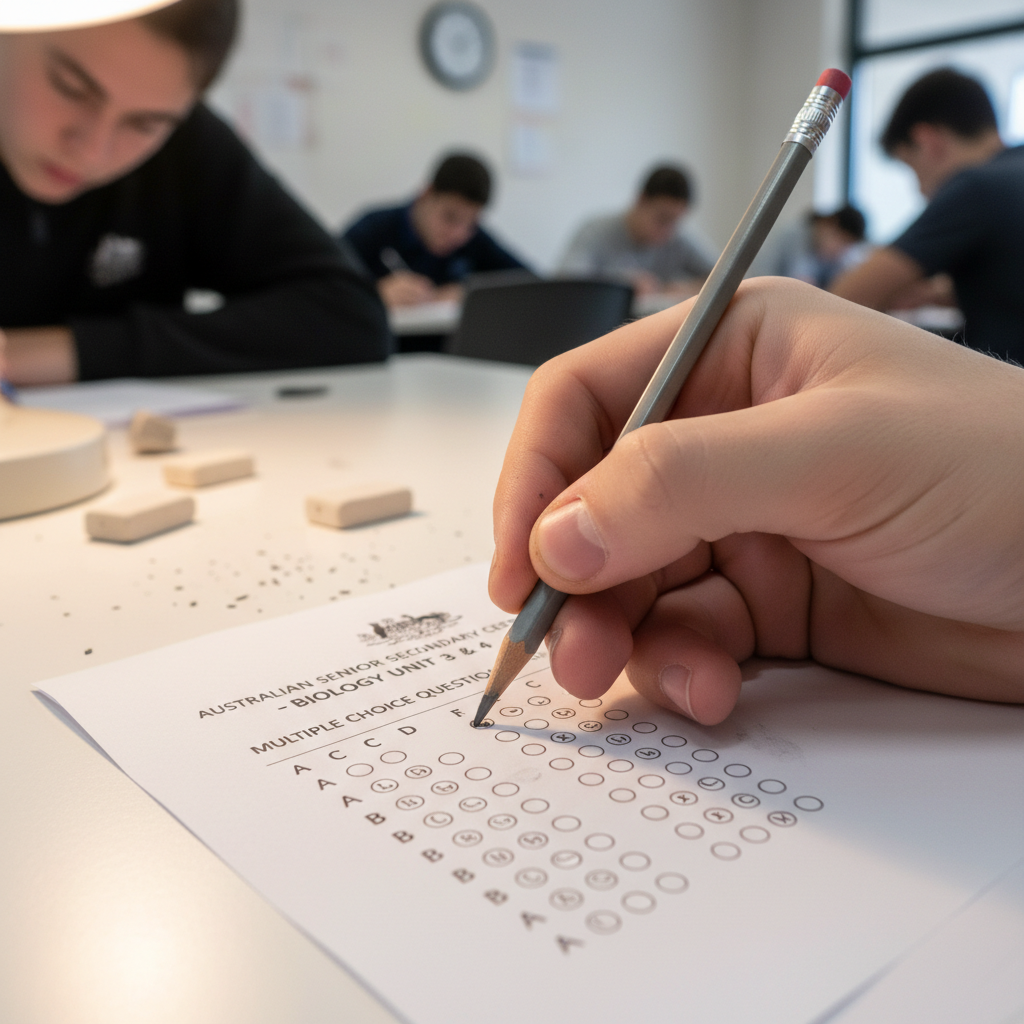
The format is unfamiliar. ICAS questions are deliberately worded to be longer and more indirect than classroom tests. Students who haven't seen this format before often spend their limited time deciphering the question style rather than solving the problem.
The time pressure is real. With dozens of complex questions and a tight time window, children who haven't practised working under exam conditions tend to slow down at the wrong moments.
The questions test reasoning, not recall. You can't cram for ICAS the way you might for a spelling test. The preparation that works is practising the thinking process — how to unpack an unfamiliar problem calmly and systematically.
Preparing for ICAS isn't about drilling endless facts. It's about helping your child understand the rules of the game before they walk into the exam room.

The Specific Topic Areas We Focus On
We don't just hand students a past paper and hope for the best. Our ICAS preparation is structured around the exact topic areas tested in each subject:
Mathematics topics we cover:
- Fractions, decimals and percentages
- Ratio and proportion
- Algebra and linear equations (Years 7–10)
- Geometry: angles, parallel lines, area and perimeter
- Statistics and probability
- Multi-step problem-solving and logical reasoning
English topics we cover:
- Reading comprehension strategies (inference, author intent, tone)
- Vocabulary in context — unfamiliar words in challenging passages
- Text structure and purpose
- Grammar, punctuation and language features
- Poetry and literary devices analysis
Students work through past papers topic by topic before moving to timed full-paper conditions — so they build genuine understanding rather than just familiarity with the format.
Our School Holiday ICAS Preparation Workshops
At Golden Pencil, we run dedicated ICAS preparation sessions during the July school holidays, specifically timed to give students the best possible foundation before the August sitting window.
Our workshops focus on:
- Working through authentic past ICAS papers — so students become familiar with the exact phrasing, format, and question types they'll encounter
- Time management strategies — we teach specific techniques to pace through a paper confidently without getting stuck
- Reasoning under pressure — students practise unpacking complex, multi-step questions in a calm, structured way
- Targeted feedback — tutors identify individual gaps and address them before the actual test
Our July holiday program includes ICAS Preparation sessions running 3:00 PM – 6:00 PM, covering both Mathematics and English. Spaces in each group are small by design to ensure every student receives meaningful attention.
Holiday workshops are running across both weeks of the July holidays. If your child has already received the school registration email and you'd like to help them make the most of it, now is a good time to secure a spot.
You can view the full schedule and enrol directly on our Holiday Program page.
A Few Final Thoughts
ICAS is a worthwhile investment for many families — not because a certificate on the wall matters, but because the diagnostic information it provides is genuinely hard to get elsewhere. The results can clarify academic strengths, identify areas for growth, and give both students and parents a more accurate picture of where things stand.
Whether or not you decide to prepare formally, going into the test with some familiarity of the format will help your child perform closer to their actual potential.
If you have questions about whether ICAS preparation is suitable for your child's year level or current ability, feel free to reach out to us directly — we're happy to chat through what would be most useful for your family.
Explore Golden Pencil